Cloud Management Services: Optimize Performance, Costs & Cloud Efficiency
Learn how cloud management services help businesses monitor performance, reduce cloud costs, and optimize infrastructure for better efficiency and long-term scalability.
Zintech Cloud Solutions Team
4/13/20263 min read

Why Do Businesses Need Cloud Management Services?
Moving to the cloud is only the first step. Once systems are live, businesses must ensure they continue to perform efficiently, remain secure, and do not become unnecessarily expensive over time.
In real-world scenarios, many businesses face challenges after migration. Cloud environments grow quickly, and without proper monitoring, costs increase, performance issues appear, and system inefficiencies go unnoticed.
For example, a business managing customer data such as user activity, transactions, and application usage may initially benefit from improved performance after migration. However, over time, unused resources, poor configuration, and increasing workloads can lead to higher costs and slower systems.
The issue is not the cloud itself — it is the lack of continuous management.
Cloud management services ensure that systems remain optimized, secure, and aligned with business needs as they evolve.
What Are Cloud Management Services?
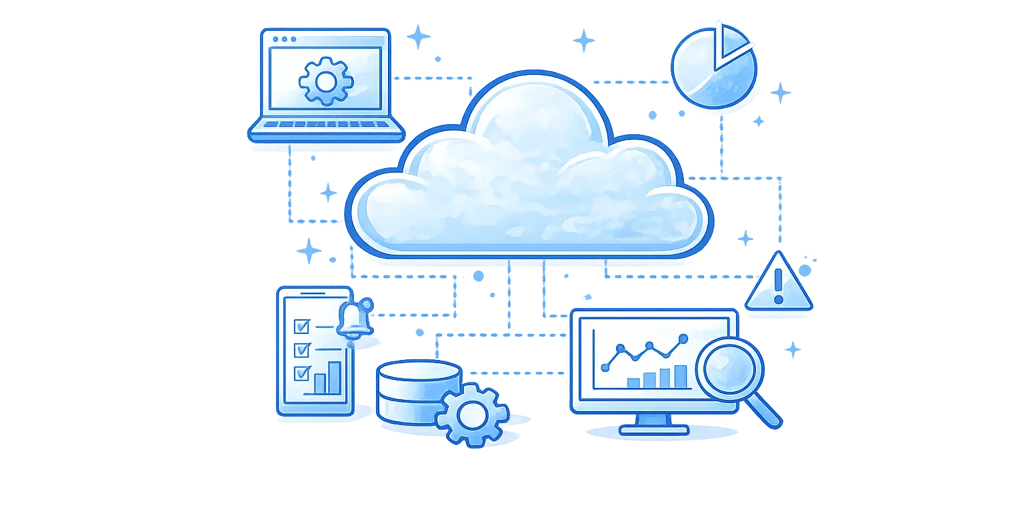
Cloud management services involve monitoring, maintaining, and optimizing cloud infrastructure to ensure consistent performance, security, and cost efficiency.
These services typically include:
Performance monitoring to identify and resolve system issues
Cost tracking and optimization to prevent unnecessary spending
Security management to protect sensitive business and customer data
Resource optimization to ensure efficient usage of cloud services
System updates and maintenance to keep infrastructure stable
The goal is to ensure that cloud systems continue to support business operations without becoming complex or expensive to manage.
How Cloud Management Works in Practice
Cloud environments are dynamic, meaning they change as your business grows. Without proper oversight, resources can become mismanaged, leading to inefficiencies.
In practical implementations, cloud management focuses on continuously analyzing how systems are being used and making adjustments to improve performance and reduce costs.
For example, consider a business storing customer data and running applications in the cloud. Over time:
Some resources may remain unused but still incur costs
Certain applications may require more computing power during peak hours
Data storage needs may increase unpredictably
Cloud management services address these challenges by:
Adjusting resources based on real-time usage
Removing unused or underutilized resources
Optimizing system configurations for better performance
Monitoring system health to prevent failures
This ensures that the cloud environment remains efficient and aligned with business requirements.
However, without proper management, businesses may experience rising costs, reduced performance, and potential security risks. This makes continuous optimization essential.
To ensure a complete cloud strategy, businesses often combine management with cloud management and migration solutions, which provide both initial setup and ongoing optimization.
Key Benefits of Cloud Management Services
Cloud management directly impacts how efficiently a business operates in the cloud.
It helps control costs by ensuring that businesses only pay for the resources they actually use. This prevents unnecessary spending caused by unused or misconfigured resources.
It improves performance by continuously monitoring systems and making adjustments based on workload demands, ensuring smooth operations even during peak usage.
It enhances security by maintaining proper access controls, monitoring threats, and ensuring compliance with best practices for data protection.
It increases reliability by identifying potential issues early and preventing system failures or downtime.
It simplifies operations by reducing the need for manual monitoring and maintenance, allowing businesses to focus on growth instead of technical management.
It also supports scalability, ensuring that systems can adapt as data, users, and workloads increase over time.
What Should Businesses Consider Before Choosing Cloud Management Services?
Choosing the right cloud management approach depends on several factors:
The complexity of your cloud infrastructure
The volume of data and system usage
Cost management requirements
Security and compliance needs
Long-term business growth plans
A structured approach ensures that cloud systems remain efficient, secure, and cost-effective.
Final Thought
Cloud management services are essential for maintaining the performance, security, and cost efficiency of cloud environments.
While cloud migration enables scalability, effective management ensures that businesses can sustain that growth without operational or financial challenges.
Businesses that actively manage their cloud systems are better positioned to optimize performance, control costs, and maintain long-term stability.

Contact Us
Ready to boost your cloud journey? Reach out!
Contact
Reach out to zintech for cloud and AI help
business@zintech.in
© 2025. All rights reserved.
Our Services
AWS Migration – Zero Downtime: Achieve 99.9% reliability and 30% TCO recovery with SRE-led transitions.
Managed Cloud Ecosystem:
24/7 full-lifecycle governance and security for global enterprise workloads.Cloud Strategy & Consulting: Strategic infrastructure modernization and AI-ready cloud transformation.
Global Operations
Headquarters: Wardha, India.
Markets Served:
United States | United Kingdom | United Arab Emirates.Technical Excellence: Specialized in AWS Cloud Architecture, Production-Level AI Solutions, and Search Intelligence.